
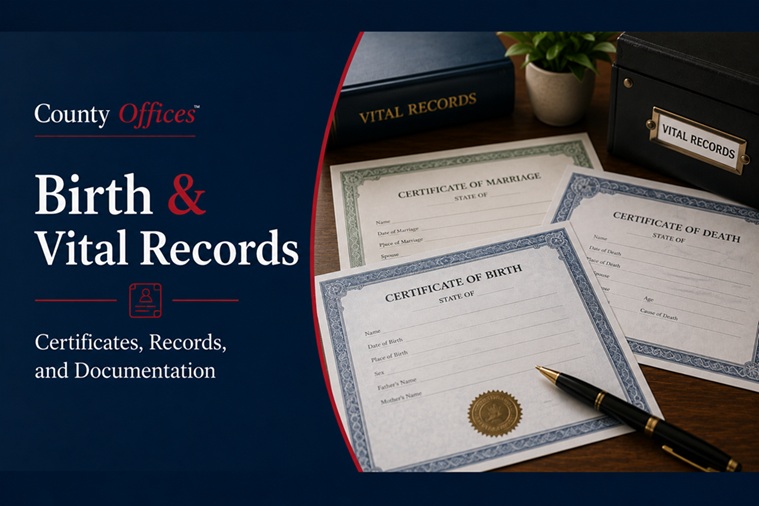
This vital records guide covers what every person needs to know about ordering birth certificates, death certificates, marriage records, and related family documents from state and county vital records offices. Vital records matters generate substantial search traffic because nearly every major life event (marriage, immigration, passport application, Social Security claim, estate administration, school enrollment, employment) requires certified copies of these documents at some point. This vital records guide explains how to order each document type, the difference between certified and informational copies, when apostilles are needed, how to correct errors on records, and where state law makes the process meaningfully different. Every state-specific vital records guide linked from this page is written for the specific procedures, fees, and timelines that apply where the event occurred.
What this vital records guide covers
The birth and vital records topic spans more ground than most people realize. This vital records guide and the supporting state guides cover six distinct areas of vital records practice, each with its own state-specific variations.
Birth certificates. Birth certificates document birth events including the person’s full name, date of birth, place of birth, and parents’ names. State vital records offices maintain birth records for events occurring in that state. Certified copies are required for passport applications, school enrollment, driver’s license, marriage license applications, Social Security cards, and many other purposes. Fees range from $10 to $35 per copy depending on the state.
Death certificates. Death certificates document death events and are essential for estate administration, bank account closures, insurance claims, Social Security notification, property transfers, and benefit claims. Most estates require multiple certified copies (typically 5-15) because each institution typically requires its own original. The funeral home often orders the initial certificates as part of their services.
Marriage and divorce records. Marriage certificates and divorce decrees are maintained partly by state vital records offices and partly by county clerks and courts. Marriage certificates are issued after the marriage ceremony when the signed license is returned. Divorce decrees are court records maintained by the family court that granted the divorce. Procedures for ordering each vary.
Document corrections and amendments. Vital records contain factual errors more often than expected. Common amendments include adding a father’s name to a birth certificate, correcting spelling errors, changing names after legal name changes, and updating the cause of death on death certificates. Each state has specific amendment procedures, fees, and required documentation.
Apostilles and authentications. Vital records being submitted to foreign countries for immigration, marriage abroad, dual citizenship applications, or international legal matters typically require an apostille (for Hague Convention countries) or authentication (for non-Hague countries). The state Secretary of State issues apostilles for state-issued vital records.
Special requests and historical research. Older vital records (typically over 75-100 years old) may be transferred from current vital records offices to state archives or made available for genealogical research. Adoption records have special access rules that vary significantly by state. Tribal vital records have separate procedures through tribal governments.
Universal vital records guide: how vital records work regardless of state
Five core questions apply to vital records matters regardless of which state controls. Each universal vital records guide linked here addresses one of them in depth.
How to get a birth certificate. Contact the vital records office in the state where the birth occurred. Most states allow online, mail, in-person, and phone ordering. Required information includes the full name on the birth certificate, date of birth, place of birth, parents’ names, and proof of your identity and relationship if you are not the person named on the certificate. The vital records guide on birth certificates walks through the process by ordering method.
When you need a certified copy versus informational. A certified copy has an official seal and signature making it acceptable for legal purposes. An informational copy contains the same information but lacks the certification and cannot be used for legal purposes. Most situations requiring a birth certificate require a certified copy. Informational copies are typically used for genealogy research only. The vital records guide on copy types covers when each is appropriate.
How to order a death certificate. Contact the vital records office in the state where the death occurred. The funeral home that handled the deceased often orders the initial death certificates. Families typically need multiple certified copies. Eligibility to order varies by state and time since death. Some states restrict death certificate orders to immediate family members and legal representatives during the first several decades. The vital records guide on death certificates covers the process.
Common vital records request mistakes. Requesters fill out forms incorrectly and have to resubmit. They order from the wrong office (city versus state, current versus historical). They pay for informational copies when they needed certified copies. They underestimate processing time and miss deadlines. They order too few death certificates and have to reorder during estate administration. The vital records guide on common mistakes catalogs the errors.
When you need an apostille on vital records. Apostilles authenticate U.S.-issued documents for use in foreign countries that are parties to the Hague Apostille Convention. Vital records being submitted for immigration, foreign marriage, dual citizenship, or international legal matters typically require an apostille. The vital records guide on apostilles covers when apostilles are required and how to obtain them.
Vital records guide by state
State law controls vital records. Each state has its own vital records office, fee structure, processing times, and access rules. Florida’s Bureau of Vital Statistics operates through the Department of Health with specific online and mail procedures. Texas vital records operate through the Department of State Health Services. California vital records are maintained by the California Department of Public Health. Each state-specific vital records guide is written for the specific procedures, fees, processing times, and required documentation that apply.
State vital records guide coverage at launch:
- Florida vital records guide
- Texas vital records guide
- California vital records guide
- New York vital records guide
- Illinois vital records guide
State vital records guide content for the remaining 45 states is being added as the site expands.
What makes vital records different across states
Beyond the universal vital records guide content and state-specific procedures, certain state-level distinctions shape outcomes significantly.
Record retention and access policies. States control when vital records are created and how long they remain restricted from public access. Most states restrict birth certificate access for 75-100 years after the birth. Death certificate access is typically restricted for 50-75 years. Marriage and divorce records have varying restrictions. After the restriction period ends, records become available for genealogical research without the proof-of-relationship requirements that apply to current records.
Online ordering availability. Most state vital records offices accept online orders through their official websites or through approved third-party services like VitalChek, which is endorsed by many state vital records offices. Some states have advanced online portals; others still require mail orders. The CDC vital records directory lists ordering options for each state.
Eligibility to order. Most states require certified copies of birth and death certificates to be ordered by the person named on the certificate, immediate family members, legal representatives, or persons with proven legal interest. Some states have stricter or more permissive rules. Genealogy researchers can typically order older records without the relationship restrictions because the records are no longer considered current.
Adoption record access. Adoption record access varies dramatically by state. Most states historically sealed adoption records, making it impossible for adopted persons to obtain original birth certificates showing biological parent information. Many states have updated their laws to allow adult adoptees access to their original birth certificates under specific conditions. The American Adoption Congress tracks state-by-state adoption record access laws.
Tribal vital records. Members of federally recognized tribes may have vital records maintained through tribal governments in addition to or instead of state vital records offices. Tribal vital records procedures vary by tribe. Persons researching tribal ancestry should consult both state vital records and applicable tribal sources. The Bureau of Indian Affairs maintains federal information on tribal recognition.
Recommended vital records guide resources
The right resource depends on what you need to accomplish.
For ordering current vital records, the state vital records office in the state where the event occurred is the authoritative source. VitalChek is the authorized third-party service used by most state vital records offices for online ordering. Avoid unaffiliated third-party services that charge significantly higher fees with no actual benefit. The state office’s official website lists the current acceptable ordering methods.
For federal authentication, the U.S. State Department Office of Authentications issues apostilles for federally issued documents. For state-issued vital records requiring apostille, the state Secretary of State office (not the State Department) issues the apostille. The Hague Conference on Private International Law maintains the list of countries that accept apostilles.
For genealogy research with older vital records, FamilySearch provides free access to historical vital records from around the world. The National Archives genealogy resources provide access to federal census records and other federal genealogy sources. State archives often hold older vital records that have aged out of current vital records office restrictions.
For background searches involving vital records, BeenVerified aggregates public records including birth, marriage, and death records along with other public information. TruthFinder provides similar aggregated records. These services are appropriate for personal research but do not provide the certified copies required for legal purposes. The BeenVerified review and TruthFinder review cover the services in detail.
Frequently asked questions
The vital records guide questions readers ask most often when starting any research come down to a handful of practical concerns. Each vital records guide answer below covers the universal framework; specific procedures vary by state.
How do I order a birth certificate?
The vital records guide approach is to contact the vital records office in the state where the birth occurred. Most states allow online, mail, in-person, and phone ordering. Required information includes the full name on the birth certificate, date of birth, place of birth, parents’ names, and proof of your identity and relationship if you are not the person named on the certificate. Fees range from $10 to $35 per copy. Processing time varies from same-day (in-person) to several weeks (mail).
What is the difference between a certified copy and informational copy?
A certified copy has an official seal and signature making it acceptable for legal purposes (passport, Social Security, marriage license, court matters). An informational copy contains the same information but lacks the certification and cannot be used for legal purposes. Most situations requiring a birth certificate require a certified copy. Informational copies are typically used for genealogy research only. Fees for certified copies are typically higher than informational copies.
How do I order a death certificate?
Contact the vital records office in the state where the death occurred. The funeral home that handled the deceased often orders the initial death certificates as part of their services. Families typically need multiple certified copies for estate administration, bank accounts, insurance claims, and Social Security notification. Eligibility to order varies by state and time since death. Some states restrict death certificate orders to immediate family members and legal representatives during the first several decades.
How many death certificates do I need?
The vital records guide recommendation is 5-15 certified copies depending on the number of accounts, insurance policies, and institutions involved. Each financial institution typically requires its own certified copy. Each life insurance company requires its own certified copy. Property transfers, vehicle title transfers, and benefit claims each require a copy. Some institutions return the copy after recording the death. Order extras initially since reordering later requires additional fees and processing time.
What is an apostille and when is it needed?
An apostille is an authentication that makes a U.S.-issued document acceptable in foreign countries that are parties to the Hague Apostille Convention. Vital records being submitted to foreign governments for immigration, marriage abroad, dual citizenship, or international legal matters typically require an apostille. The state Secretary of State office issues apostilles for vital records issued by that state.
Can I get someone else’s birth certificate?
Eligibility to order another person’s birth certificate varies by state and the requestor’s relationship. Most states allow immediate family members, the person’s legal representative, and persons with proven legal interest to order certified copies. Some states restrict access entirely, requiring court orders for non-family members. Genealogy researchers can typically order older birth certificates (often those over 75-100 years old) without the relationship restrictions.
How do I correct a birth certificate?
Birth certificate amendments require completing the state’s amendment form, providing supporting documentation, and paying an amendment fee. Common amendments include adding the father’s name, correcting spelling errors, and changing names after legal name change. Some amendments require court orders, particularly significant changes to parentage or major identity changes. The state vital records office processes amendments; turnaround times can be several months for complex cases.
How do I order a marriage certificate?
Marriage certificates are issued by the county clerk where the marriage was recorded, the state vital records office, or both depending on the state. Required information includes both spouses’ names, date of marriage, county of marriage, and your relationship to the parties if not yourself. Fees vary by state and county. The marriage certificate is the document used for name changes and legal purposes; the marriage license is the pre-marriage authorization document.
How do I get a copy of my divorce decree?
Divorce decrees are court records maintained by the clerk of court in the county where the divorce was granted, not by the vital records office. Some states also maintain divorce indexes at the state vital records office. To order a copy, contact the family court clerk in the county where the divorce was finalized. Provide both spouses’ names, date of divorce, and case number if known. Fees and copy turnaround times vary by court.
Can I get vital records online?
Most state vital records offices accept online orders through their official websites or through approved third-party services like VitalChek, endorsed by many state vital records offices for online ordering. Beware of unaffiliated third-party services that charge significantly higher fees with no actual benefit. Always order through the state’s official website or VitalChek where available. Online orders typically cost slightly more than mail orders due to processing fees.
How long does it take to get vital records?
Vital records guide processing times vary significantly. In-person orders are often same-day. Online expedited orders typically arrive in 5-10 business days. Mail orders take 4-8 weeks in most states. Some states have substantial backlogs that extend processing to 12+ weeks. Plan ahead for time-sensitive needs. If urgent, order in person at the state vital records office or through expedited online services. Funeral homes can often expedite initial death certificate orders.
What is the difference between state and county vital records offices?
State vital records offices maintain official statewide registries of births, deaths, and marriages occurring in the state. County clerks maintain local records of marriages performed in their county and sometimes provide local copies of birth and death certificates for events in their county. State offices are usually the most reliable source for certified copies. County clerks are often faster for local records. Each vital records guide covers where to order each record type by state.
Related life event topics
Vital records matters frequently overlap with other county-level life events. The topics most commonly connected to this vital records guide:
Estate and probate. Death certificates are required for nearly every step of probate. Certified copies must be ordered from the state vital records office where the death occurred. Estates frequently require multiple certified copies for different institutions.
Marriage and divorce. Birth certificates are required for marriage license applications when proving age. Children’s birth certificates may need updating after parental name changes or remarriage. Marriage certificates are vital records that connect to the marriage license process.
Genealogy and family history. Vital records are the foundation of genealogy research. Birth, marriage, and death records document family relationships across generations. Older vital records become accessible to genealogy researchers after state-specific restriction periods expire.
Court records and legal. Divorce decrees are court records, not vital records, though they document family status changes. Vital records may be needed for court matters including name changes, immigration cases, and estate litigation.
Seniors and aging. Death certificates are essential for senior estate administration, Social Security survivor benefits, and pension claims. Senior identity documentation including birth certificates may need replacement after decades.
Sources and references
The vital records guide content on CountyOffices is based on state vital records statutes, federal authentication procedures, and Hague Convention requirements. Source materials include state vital records office publications, the CDC National Center for Health Statistics directory, and federal authentication regulations.
External authority sources cited in this vital records guide:
- CDC National Center for Health Statistics (state vital records directory)
- VitalChek (authorized third-party ordering service)
- U.S. State Department Office of Authentications (federal document authentication)
- Hague Conference on Private International Law (apostille convention countries)
- FamilySearch (free genealogy database with historical vital records)
- National Archives genealogy resources (federal genealogy resources)
- American Adoption Congress (adoption record access laws by state)
- Bureau of Indian Affairs (tribal vital records information)
Each state vital records guide cites the relevant state office, fee structure, and procedures specific to that state. Last reviewed dates are visible on every vital records guide.
This vital records guide is informational only. For specific situations, contact the vital records office in the state where the event occurred.