
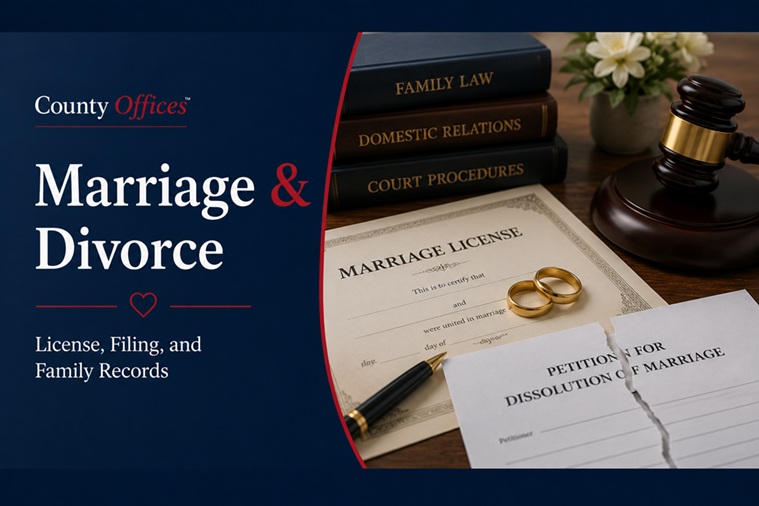
This marriage license guide covers what couples need to know about getting married, filing for divorce, changing names, and obtaining family records at the county level. Marriage and divorce matters generate enormous search volume because the procedures vary dramatically by state and by county, the deadlines have real consequences, and most people only navigate the system once or twice in their lifetime. This marriage license guide explains how to obtain a license, the waiting periods and validity windows, the procedures for officiants, the name change process after marriage, how to file for divorce, and where state law makes the process meaningfully different. Every state-specific marriage license guide linked from this page is written for the specific requirements, fees, forms, and county procedures that apply where the marriage takes place.
What this marriage license guide covers
The marriage and divorce topic spans more ground than most couples realize. This marriage license guide and the supporting state guides cover six distinct areas of family law and practice, each with its own state-specific variations.
Marriage license requirements and procedures. Each state has its own rules for who can marry, what documents are required, application procedures, waiting periods between application and license issuance, license validity windows, and who can perform the ceremony. Some states require both applicants to appear in person; others allow online application. Some have mandatory premarital counseling discounts; others have no waiting period at all. Application fees range from $25 to over $100 depending on state and county.
Name change after marriage. Marriage is the most common legal name change in the United States. The marriage certificate (not the license) is the document used to change names with Social Security, the DMV, passports, and other institutions. Each state has specific rules about what names can be adopted at marriage. Some states limit options to spouse’s surname or hyphenated forms; others allow complete name changes. Court orders are sometimes required for non-traditional changes.
Divorce filing and procedures. Divorce procedures vary significantly by state regarding residency requirements, grounds for divorce, mandatory waiting periods, financial disclosure requirements, property division rules, and child custody determinations. Most states now allow no-fault divorce without proving misconduct. Filing fees range from $100 to $400. The process can take 30 days for uncontested divorces in some states to several years for contested divorces.
Marriage and divorce records. Marriage certificates, divorce decrees, and related family records are maintained by both state vital records offices and county clerks. Procedures for ordering certified copies vary. Some records are public; others have access restrictions. Family records are required for passport applications, Social Security claims, immigration matters, estate administration, and many other purposes.
Spousal support and property division. Divorce involves dividing marital assets and debts and sometimes determining spousal support obligations. Community property states (Arizona, California, Idaho, Louisiana, Nevada, New Mexico, Texas, Washington, Wisconsin) treat marital property roughly equally regardless of titling. Common law states use equitable distribution principles that consider multiple factors. Spousal support availability and calculation differs significantly by state.
Child custody and family court matters. Marriage and divorce involving minor children trigger family court jurisdiction over custody, visitation, and child support. The best interests of the child is the standard across all states, but specific factors and procedures vary. Custody disputes are the most contentious and time-consuming aspect of divorce litigation. Mediation is required in many states before contested custody hearings.
Universal marriage license guide: how marriage works regardless of state
Five core questions apply to marriage and divorce matters regardless of which state controls. Each universal marriage license guide linked here addresses one of them in depth.
How to get a marriage license. Application at the county clerk’s office, required documents (government ID, proof of age, Social Security numbers, divorce decrees or death certificates for previously married applicants), application fees, waiting periods, and license validity windows. Most states allow application in any county within the state. Both applicants typically must appear in person at application. The marriage license guide on the process walks through each step.
When you need a license versus certificate. A marriage license is the authorization to marry, issued before the wedding by the county clerk. A marriage certificate is the proof that the marriage occurred, issued after the ceremony when the signed license is returned to the county. The two documents serve different purposes. License copies are typically used in the marriage process itself. Certificate copies are used for name changes, immigration, Social Security, and most other purposes. The marriage license guide on documents explains when each is needed.
How to file for divorce. Filing requires completing the divorce petition, filing it with the family court in the county where you or your spouse resides, paying the filing fee, and serving the petition on the other spouse. State residency requirements apply, typically six months to one year. Financial disclosure follows. Asset division, child custody determinations, and spousal support claims are resolved through agreement or court order. The marriage license guide on divorce filing covers the process.
Common divorce filing mistakes. Couples file in the wrong county and have to start over. Spouses fail to disclose assets and face perjury consequences. One party serves the petition improperly and the case is dismissed. Custody disputes escalate when they should have been mediated. Property valuation errors cost thousands in division. The marriage license guide to common mistakes catalogs the costly errors.
When to hire a divorce attorney. Uncontested divorces with no children, no significant assets, and no spousal support claims can often proceed without attorneys using state-provided forms or document services. Contested divorces, divorces involving children, divorces with significant assets, or divorces with one party seeking spousal support typically benefit from attorney representation. The marriage license guide on hiring attorneys covers the decision framework.
Marriage license guide by state
State law controls marriage and divorce. Each state has its own marriage license requirements, waiting periods, divorce residency requirements, no-fault grounds, and property division rules. Texas requires a 72-hour waiting period between license issuance and the marriage ceremony. Florida has a 3-day waiting period for residents but no waiting period for non-residents or those completing a premarital preparation course. California requires a 6-month waiting period from divorce petition service to finalization. Each state-specific marriage license guide is written for the specific timelines, forms, and procedures that apply.
State marriage license guide coverage at launch:
- Florida marriage and divorce guide
- Texas marriage and divorce guide
- California marriage and divorce guide
- New York marriage and divorce guide
- Illinois marriage and divorce guide
State marriage license guide content for the remaining 45 states is being added as the site expands.
What makes marriage and divorce different across states
Beyond the universal marriage license guide content and state-specific procedures, certain state-level distinctions shape outcomes significantly.
Community property versus common law. Nine states (Arizona, California, Idaho, Louisiana, Nevada, New Mexico, Texas, Washington, Wisconsin) are community property states. Property acquired during marriage belongs equally to both spouses regardless of titling. Common law states treat property based on equitable distribution principles that consider marriage duration, each spouse’s contribution, and future earning capacity. The distinction affects divorce settlements significantly.
Waiting periods. Texas requires 72 hours between license issuance and the marriage ceremony. Florida has a 3-day waiting period for residents. Most states have no waiting period. Wisconsin requires a 5-day waiting period after application. The waiting period applies between application and license issuance, between license issuance and the ceremony, or both depending on the state. Verify your state’s specific rules before planning the ceremony date.
No-fault divorce grounds. Every state now allows some form of no-fault divorce, but the specific grounds vary. Most states accept “irreconcilable differences” or “irretrievable breakdown” as sufficient grounds. Some states still require living apart for a specified period before no-fault divorce is granted. A few states have minimum separation requirements ranging from 30 days to one year. The American Bar Association family law section covers state-by-state grounds.
Covenant marriage. Three states (Arizona, Arkansas, Louisiana) offer covenant marriage as an alternative form of marriage with restricted grounds for divorce and required premarital counseling. Couples must specifically elect covenant marriage at the time of marriage license application. Few couples in these states choose covenant marriage. The intent is to make marriage more deliberate and divorce more difficult.
Recognition of common-law marriage. A small number of states still recognize common-law marriage (Colorado, Iowa, Kansas, Montana, Oklahoma, Rhode Island, South Carolina, Texas, Utah, and the District of Columbia). Common-law marriage requires meeting state-specific criteria, typically including cohabitation, holding out as married, and present intent to be married. Most states have eliminated common-law marriage. Once established, common-law marriage requires formal divorce to end.
Recommended marriage license guide resources
The right professional help depends on what you need to accomplish.
For uncontested divorce and document preparation, LegalZoom provides state-specific divorce forms, completion guidance, and filing assistance. LawDepot offers DIY templates for divorce and family law matters. Both services produce legally valid forms when used correctly for straightforward situations. Complex cases (children, significant assets, spousal support claims) typically require attorney involvement beyond document services.
For divorce and family law attorneys, the American Bar Association legal help directory connects users with state bar association referral services. Initial consultations are often free or low-cost. Family law attorneys handle contested divorces, custody disputes, asset division litigation, and complex family matters. Attorney involvement makes sense when the dollar amount or custody outcome at stake is significant.
For mediation services, mediation is often required before contested custody hearings and can be voluntary in any divorce. The Association for Conflict Resolution maintains professional standards for mediators. Mediation can resolve disputes faster and less expensively than contested litigation while preserving relationships better, particularly for couples with children who will continue co-parenting.
For vital records and certificate orders, the state vital records office and the county clerk where the marriage was recorded are the authoritative sources. The CDC vital records directory lists the office for each state. Certified copies are required for legal purposes like name changes, immigration matters, and Social Security claims. Most states allow online ordering through approved services like VitalChek.
Frequently asked questions
The marriage license guide questions readers ask most often when starting any research come down to a handful of practical concerns. Each marriage license guide answer below covers the universal framework; specific procedures vary by state.
How do I get a marriage license?
Every marriage license guide starts with the application process. Apply in person at the county clerk’s office in the county where you plan to marry. Most states allow application in any county within the state. Both applicants typically must appear together. Required documents include government-issued photo ID, proof of age, and Social Security numbers. Some states require divorce decrees or death certificates for previously married applicants. Application fees range from $25 to $115 depending on state and county.
How long is a marriage license valid?
Validity periods vary by state, and the marriage license guide for your specific state will confirm the exact window. Most states issue licenses valid for 30 to 90 days from issuance. Florida licenses are valid for 60 days. Texas licenses are valid for 90 days. California licenses are valid for 90 days. If the marriage does not occur within the validity period, the license expires and a new license must be obtained. The marriage ceremony must be performed within the validity period for the license to be legally effective.
Do all states require a marriage waiting period?
No, but several do. Texas requires a 72-hour waiting period between license issuance and the marriage ceremony. Florida has a 3-day waiting period for residents but no waiting period for non-residents or those completing a premarital preparation course. Wisconsin requires 5 days after application. Most states have no waiting period at all. The waiting period applies between application and license issuance, between license issuance and the ceremony, or both depending on the state.
How do I change my name after marriage?
The marriage license guide approach to name change starts with obtaining certified copies of the marriage certificate from the county clerk where the marriage was recorded. The marriage certificate (not the license) is the document used for name change. Update Social Security records first by visiting a local Social Security Administration office with the marriage certificate and ID. Then update driver’s license, passport, bank accounts, and other records.
How do I file for divorce?
Filing requires completing the petition for divorce and filing it with the family court in the county where you or your spouse resides. State residency requirements apply, typically requiring six months to one year of residency before filing. Filing fees range from $100 to $400. The petition must be served on the other spouse. The divorce process involves financial disclosure, asset division, child custody determinations (if applicable), and possibly mediation.
How long does divorce take?
Uncontested divorces can finalize in 30 to 90 days after filing, subject to state-mandated waiting periods. California requires a 6-month waiting period from the date the petition is served. Texas requires 60 days. Florida has no mandatory waiting period for uncontested cases. Contested divorces involving asset disputes, custody disputes, or alimony disputes can take six months to two years or longer. Court calendar availability affects the timeline more than state requirements.
What is the difference between divorce and annulment?
Divorce ends a valid marriage. Annulment declares that a marriage was never valid from the beginning. Grounds for annulment vary by state but typically include fraud, lack of capacity at the time of marriage, bigamy, incest, underage marriage without consent, and force or duress. Annulments are less common than divorces. The legal consequences differ regarding property division, spousal support, and the status of children.
Do I need an attorney to divorce?
No, but it depends on circumstances. The marriage license guide framework distinguishes simple from complex cases. Uncontested divorces with no children, no significant assets, and no spousal support claims can often proceed without attorneys using state-provided forms or services like LegalZoom divorce services. Contested divorces, divorces involving children, divorces with significant assets, or divorces with one party seeking spousal support typically benefit from attorney representation.
How do I get a copy of my marriage certificate?
Marriage certificates are issued by the state vital records office, the county clerk where the marriage was recorded, or both depending on the state. To request a copy, contact the relevant office with the names of both spouses, date of marriage, location of marriage, and your relationship to the parties. Fees range from $5 to $30 per copy. The CDC vital records directory lists each state’s office.
What is a covenant marriage?
Covenant marriage is an alternative form of marriage available in Arizona, Arkansas, and Louisiana. Couples who choose covenant marriage agree to premarital counseling, accept restricted grounds for divorce, and commit to marriage counseling if marital problems arise. The intent is to make marriage more deliberate and divorce more difficult. Few couples in these states choose covenant marriage over traditional marriage. The choice is made at the time of marriage license application.
How does property division work in divorce?
Property division is one of the most common marriage license guide questions and depends on whether the state is a community property state or a common law state. Community property states (Arizona, California, Idaho, Louisiana, Nevada, New Mexico, Texas, Washington, Wisconsin) divide marital property roughly equally regardless of whose name is on title. Common law states divide property based on equitable distribution principles that consider factors including marriage duration, each spouse’s contribution, and future earning capacity.
What records does the county keep about marriage and divorce?
County clerks maintain marriage license applications, marriage certificates, and divorce decrees. These are generally public records, though some divorce records may be sealed in cases involving minor children or sensitive financial information. Vital records are typically available from the state’s vital records office for genealogical and legal purposes. State guides cover specific procedures for ordering each type of record.
Related life event topics
Marriage and divorce matters frequently overlap with other county-level life events. The topics most commonly connected to this marriage license guide:
Estate and probate. Marriage and divorce status affect probate outcomes through spousal elective share rules, community property rules, and intestate succession. Divorce typically revokes provisions in a will that favored the former spouse. Marriage usually grants the new spouse elective share rights regardless of an older will’s terms.
Property and real estate. Property ownership changes during marriage and divorce affect title and tax status. Community property states treat marital property differently than common law states. Divorce decrees often include property transfer orders that require deed recording.
Birth and vital records. Birth certificates are required for marriage license applications when proving age. Children’s birth certificates may need updating after parental name changes or remarriage. Vital records procedures connect family events across generations.
Court records and legal. Divorce records are court records maintained by the family court. Some divorce filings are public; some are sealed. Family law matters generate substantial court record activity through child support enforcement, custody modification, and post-divorce litigation.
Genealogy and family history. Marriage and divorce records are essential for genealogical research. Marriage certificates document spousal relationships across generations. Divorce records reveal information sometimes unavailable elsewhere about family disruption and reformation.
Sources and references
The marriage license guide content on CountyOffices is based on each state’s marriage and family law statutes, court rules, and county procedures. Source materials include state statutes, county clerk publications, state vital records office guidance, and federal regulations governing Social Security name changes.
External authority sources cited in this marriage license guide:
- Social Security Administration (name change procedures)
- CDC National Center for Health Statistics (state vital records directory)
- American Bar Association family law section (family law resources)
- American Bar Association legal help directory (family law attorney referrals)
- Association for Conflict Resolution (mediator standards)
- VitalChek (authorized vital records ordering service)
Each state marriage license guide cites the relevant state code sections, court rules, and county procedures specific to that state. Last reviewed dates are visible on every marriage license guide.
This marriage license guide is informational only and does not constitute legal advice. For advice specific to your situation, consult a licensed family law attorney in your state.